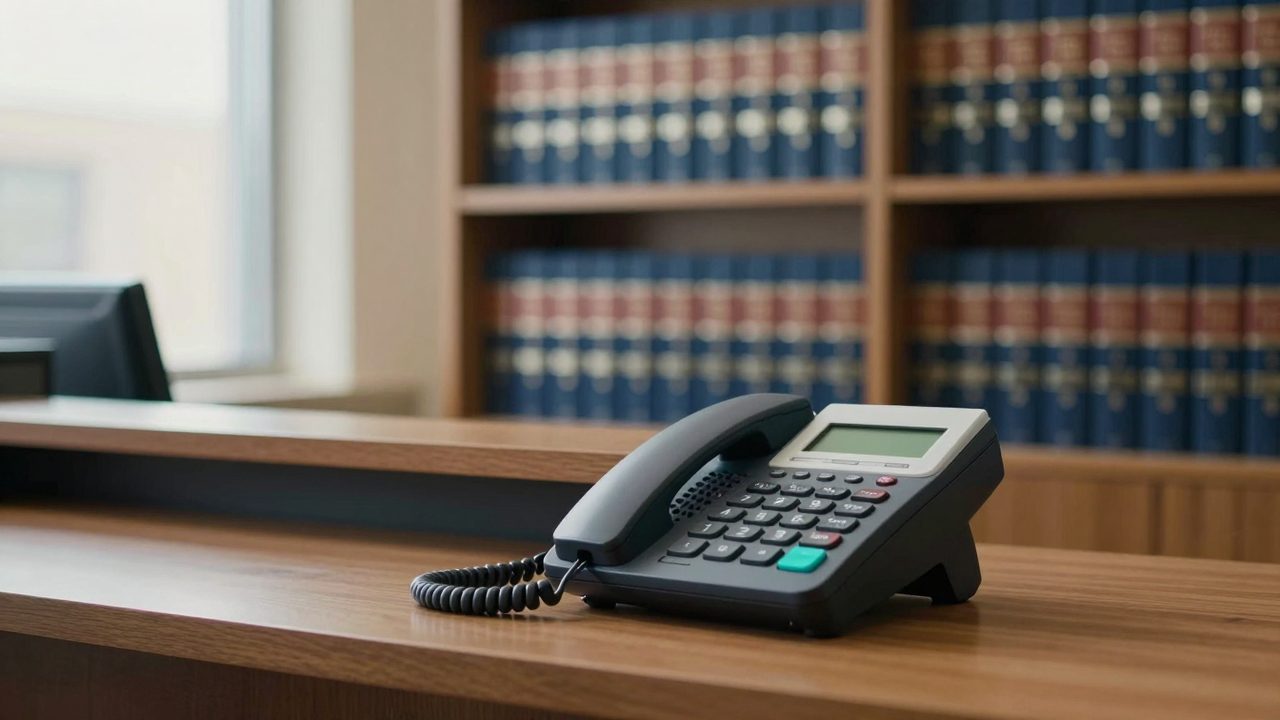
The calls a law firm misses, and the hours it misses them in
Legal enquiries do not arrive during office hours, because legal problems do not. The arrest happens on a Friday night, the spouse moves out on a Sunday, the termination letter is handed over at 5:30pm on a Friday, and the accident report arrives with a deadline already printed on it. Those callers are dialling from a search results page with three other firms still open in other tabs. They ring the next name on the list rather than wait for a callback. Daytime is not much safer. A small firm's phone rings while the only lawyer is in a hearing, in a deposition, or in a client meeting that cannot be interrupted, and the person covering reception is the same paralegal drafting the filing due that afternoon. What you get is a stack of voicemails returned two or three hours later, by which point the prospective client has booked a consultation elsewhere. Then there is everything that is not a new matter: an existing client asking whether the hearing date moved, a process server, opposing counsel, a court clerk, a billing question, and a steady stream of people whose problem is nowhere near your practice areas. All of it lands on the same line.
What a missed intake call actually costs you
Every enquiry that goes to voicemail is paid for twice. Once in whatever produced it: a firm advertising for personal injury, family or criminal work is effectively buying each ring on its own, and a referral costs a relationship. And once in the matter itself, which goes to the firm that answered. The second cost never appears in a report, because you never find out what the case was worth. The quieter cost is who answers instead. When intake lands on a paralegal or an associate, you are paying billable-grade attention to write down a name and a number, and the interruption costs more than the minutes it consumes. Drafting picked up after a phone call does not resume where it stopped. Routing the phones to a legal answering service trades one problem for another. An operator who writes down "someone called about a divorce, here is the number" has created a callback task, not an intake, and that callback still has to beat the two other firms the caller tried. Meanwhile the calls that never deserved a lawyer's attention, wrong practice area, wrong state, a question about an invoice, get handled exactly like the ones that did.
What the AI receptionist handles from start to finish
Comturk AI answers on the first ring, day or night, tells the caller it is an AI, and then does the work rather than taking a message. For a new matter it runs a structured intake: name and contact details, matter type, the dates that matter, the court or jurisdiction if there is one, the other side's name, how the caller found you, plus whatever else you add for a particular practice area, such as the date of the accident, the date of service or the last day of employment. It answers questions from your own approved documents and your website. What a consultation costs and how long it runs, what to bring, whether you take that kind of case, which office, where to park. If the answer is not in the material you approved, it says so instead of improvising. It books the consultation into the real calendar, the right lawyer's calendar, respecting your durations and buffers, and it can move or cancel that appointment when the caller rings back. It writes the record into your intake system. It can also run outbound follow-up on enquiries that stalled, with quiet hours, consent and QA scoring handled in a compliance centre. Every call produces a transcript and a record.
What still has to reach a lawyer, and how the handover works
Some calls should never be handled by software, and the question worth asking a vendor is not whether the AI can talk to them but how quickly it gets out of the way. Courts and clerks, opposing counsel, process servers, an existing client with a hearing tomorrow, a caller in real distress, anything with a deadline attached: you define those categories, and the AI transfers them instead of interviewing them. The transfer is warm. Whoever picks up already has the caller's name, the reason for the call and the transcript so far, so nobody has to make a distressed person start over. When no one is available, the AI says so honestly, takes the details, marks the call by urgency and sends the summary where you want it, which is often one lawyer's phone at 11pm and a shared inbox during business hours. There is also a category it declines on purpose. It does not assess the merits of a claim, predict an outcome, tell a caller whether a limitation period has run, or say anything that a caller could reasonably read as advice from your firm. It collects facts and books the meeting where advice is given. That boundary is written into its instructions and its approved knowledge.
Connecting it to Clio, MyCase and the rest of your stack
A call is only useful if it ends up inside the system the firm already runs on. Comturk AI connects to other software through approved actions and its API: you decide which actions exist, create a contact, open a matter, write a call note, check availability, book an event, and the assistant is allowed to call those and nothing else. That is how firms wire it to practice management platforms like Clio, along with Clio Grow on the intake and CRM side, MyCase, PracticePanther, Smokeball, which small firms use partly for its automatic time capture, and Filevine, which litigation-heavy practices use for case management. These are connections a customer configures against those products' APIs, not certified integrations shipped by the vendors, so what is possible depends on the plan and API access your firm holds. Worth checking that before you commit to a workflow. Calendars work the same way, Google Calendar or Microsoft 365, whichever one the lawyers actually keep hearings in. And if you have no case management system yet, nothing breaks: the assistant still produces a full intake record and a transcript for every call and can send them wherever you keep things today.
Setting it up: keep your number, connect your knowledge, go live
You keep your number and you keep your carrier. Comturk AI is not a telephone operator. It does not sell numbers and it does not bill call charges, so your operator carries on doing both and carries on invoicing you directly. In the US that means Telnyx, Twilio, RingCentral or whoever holds the number today; in Turkey, Netgsm or Verimor. The number is connected to Comturk AI over SIP, and the porting exercise you were dreading does not happen. Next you connect knowledge. Point the system at your website and upload the material you are willing to have quoted back to a caller: practice area descriptions, consultation fees, the intake questions you actually ask, office and parking details. That approved set is what the assistant answers from. Then you write the rules. Which matter types you take and which you decline, who gets transferred immediately, what happens after hours, which calendar belongs to which lawyer, how long a consultation runs. Most firms do not switch everything at once. Start with the hours nobody covers, evenings, weekends, lunch, add overflow when the line is busy, then move daytime reception across once you have read a week of transcripts.
Confidentiality, disclosure and the recording question
A prospective client tells an intake call things they would not tell a stranger, and the duty of confidentiality owed to prospective clients does not wait until you take the matter. So treat the transcript the way you would treat a paralegal's intake notes: decide who inside the firm can read them, decide how long they are kept, and set retention deliberately rather than inheriting a default. Recording is a jurisdictional question rather than a product question. Consent rules differ by state in the US and by country elsewhere, so what the assistant announces at the start of the call is something you define with us during onboarding. Disclosing that the caller is speaking to an AI does not require keeping the audio. Conflicts deserve the same honesty. The assistant can capture every party name a caller mentions and check it against the list or system you connect, then flag a possible hit before the consultation is confirmed. It does not clear a conflict. A person at your firm still does that, only now with the names in hand on Saturday night instead of Monday morning. And when any vendor implies a certification, ask precisely what they hold.
Works alongside: Clio · Clio Grow · MyCase · Filevine · Smokeball · PracticePanther